
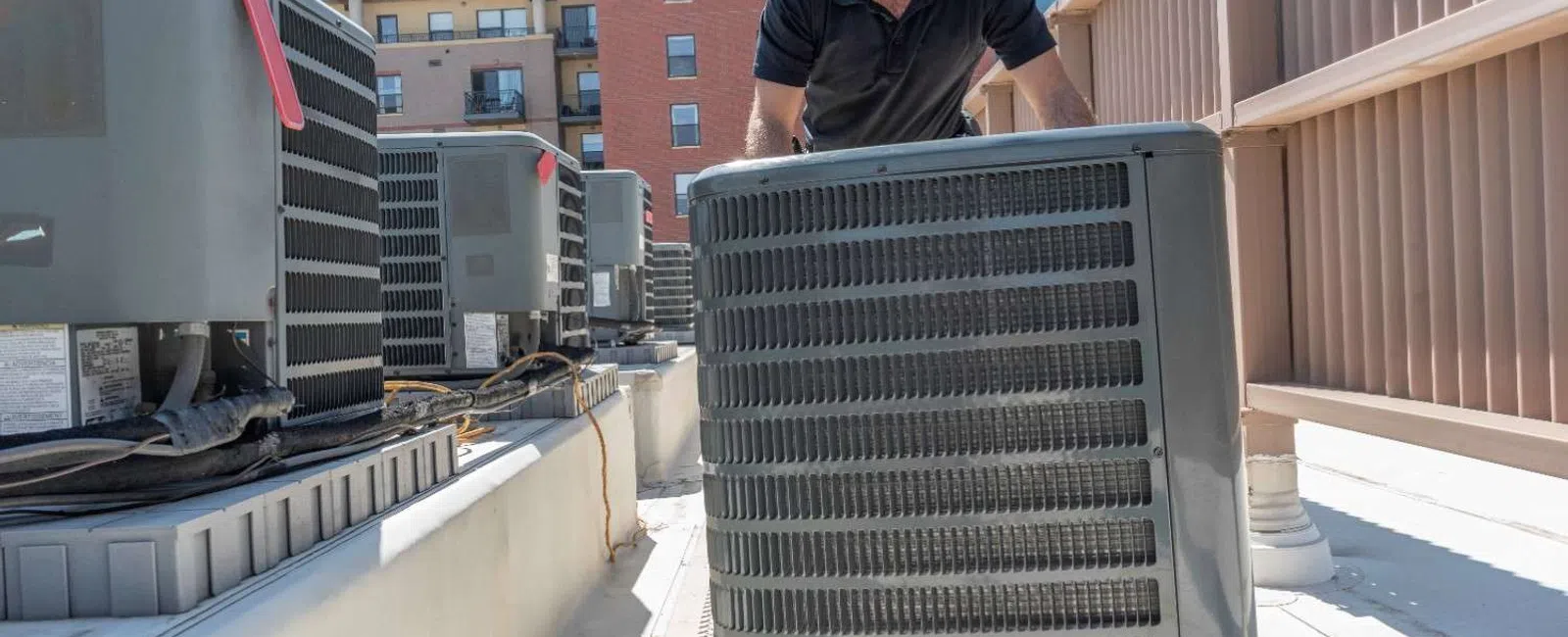
How commercial systems differ from residential
Commercial
equipment is not just a larger version of what sits beside a house. It carries larger and more variable loads, conditions many zones with different occupancies and heat gains, and usually lives on the roof or in a dedicated mechanical room rather than in a side yard. Ventilation and fresh-air requirements are stricter,
controls are more involved, and most systems are expected to run close to
continuously during business hours. That combination changes everything
downstream, from how a system is sized to how often it needs service. A unit
that short cycles or drifts out of charge in a full building shows up quickly
as heat complaints and spoiled product.
The five commercial HVAC
systems you will encounter
Single-split systems
Single-split
systems pair one outdoor condenser with one indoor air handler, and they are
the workhorse for small commercial spaces: a boutique, a compact office suite,
a restaurant dining room. They are economical per zone, easy to source parts
for, and simple to service. The tradeoff is scale. Cover a large building with
single-splits, and you end up managing a crowd of separate systems, each with
its own refrigerant lines and failure points. For a single-tenant space, a
well-matched single-split is hard to beat, and it uses the same core technology
as residential air
conditioning installation, scaled for light commercial use.
Multi-split systems
A multi-split
connects several indoor units to one outdoor unit, reducing rooftop and exterior clutter while still allowing each space to maintain its own temperature.
Medical offices, mixed retail, and buildings with limited outdoor space lean on
this design. Because one condenser serves multiple heads, sizing and
refrigerant line design matter more than they do with a single-split, and a
rushed install shows up later as uneven cooling from one room to the next.
Packaged rooftop units
(RTUs)
The rooftop
unit is the most common thing you will see on a commercial building in Georgia,
and for good reason. An RTU packages the compressor, coils, and air handling
into one cabinet that sits on the roof, keeps noisy equipment out of occupied
space, and frees up square footage inside. Retail centers, warehouses, schools,
and standalone stores run on them. They are modular, so a larger footprint
simply means more units. Rooftop placement also means sun, storms, and debris
work on them year-round, which is exactly why they need a real maintenance
schedule rather than an as-needed one.
Variable refrigerant
flow (VRF / VRV)
Variable
refrigerant flow systems, sold as VRV by some manufacturers, are the modern
answer for buildings that need precise, independent control across many zones.
VRF can heat one part of a building while cooling another by routing
refrigerant where it is needed, and it modulates capacity instead of cycling
hard on and off, which saves energy through a long Georgia cooling season.
Hotels, larger offices, and multi-use buildings are common candidates. The
technology overlaps with heat pump
systems and shares its DNA with the ductless mini split, so a
contractor who installs those already understands how VRF behaves. It asks for
more up front and depends on skilled commissioning to run right.
Chilled water systems
(chillers)
Chilled water
systems, or chillers, are built for the largest loads: hospitals, campuses,
high rises, and industrial plants. Rather than moving refrigerant throughout
the building, a chiller cools water that gets pumped to air handlers or fan
coils across the facility. Air-cooled and water-cooled variants exist, and the
choice depends on building size, water access, and available roof or plant
space. Chillers are efficient at scale and long-lived, but they are also the
most complex system here and belong with technicians who work on them
regularly.
Commercial
HVAC systems at a glance
|
System |
Best fit |
Where it
lives |
Georgia
climate note |
|
Single-split |
One or two small tenant
spaces |
Exterior pad or wall |
Simple to service;
multiplies fast in larger buildings |
|
Multi-split |
Medical, mixed retail, tight
lots |
One outdoor unit, several
indoor heads |
Line-set design drives even
cooling across rooms |
|
Packaged rooftop unit (RTU) |
Retail, warehouse, schools,
standalone stores |
On the roof, self-contained |
Takes full sun and storms;
needs a real service schedule |
|
VRF / VRV |
Hotels, larger offices,
multi-use |
Modular indoor units, one
condenser bank |
Modulates for long cooling
seasons; heats and cools at once |
|
Chiller (chilled water) |
Hospitals, campuses, high
rises |
Mechanical room or plant |
Efficient at scale; most complex to maintain |
Choosing the right system
for your building
System type is
only the starting point. The right choice comes out of a real commercial load
calculation, not a rule of thumb or a match to whatever was there before. Roof
space and mechanical room availability decide whether packaged or split
equipment makes sense. The number of zones and how differently they are used
point toward multi-split or VRF. Redundancy matters for spaces that cannot
afford downtime, such as server rooms or medical suites, where losing one unit
should never take the whole floor offline. Heating deserves the same planning
as cooling, and pairing the right equipment with proper commercial heating
installation keeps a building comfortable through the cold snaps that do
hit north Georgia. Humidity control deserves its own line item too. A system
sized only for temperature can reach the setpoint while leaving the air clammy,
so dehumidification capacity and airflow belong in the conversation from the
start.
What commercial HVAC
maintenance actually involves
Commercial systems tend to fail on a schedule you can predict, which means most failures are preventable. A working maintenance program covers coil cleaning, belt and bearing inspection, refrigerant charge verification, economizer and damper function, condensate drain clearing, and filter changes on an actual calendar rather than whenever someone remembers. Georgia's humidity makes that drain line a recurring culprit, since a clogged condensate line backs up fast and can shut a unit down or damage the space below it. Rooftop units take the added beating of weather and earn a seasonal maintenance visit going into both cooling and heating loads. Buildings that stay on a plan see fewer surprise outages and get more years out of the equipment, and when something does go wrong, they are not scrambling for emergency repair during a July heat wave.
Get the right system for your building
Running a commercial property in metro Atlanta? MR. HVAC installs, replaces, and maintains every system above, from single-splits to rooftop units and chillers. Schedule commercial service and get an honest read on what your building actually needs, not a quote for whatever was there before


