
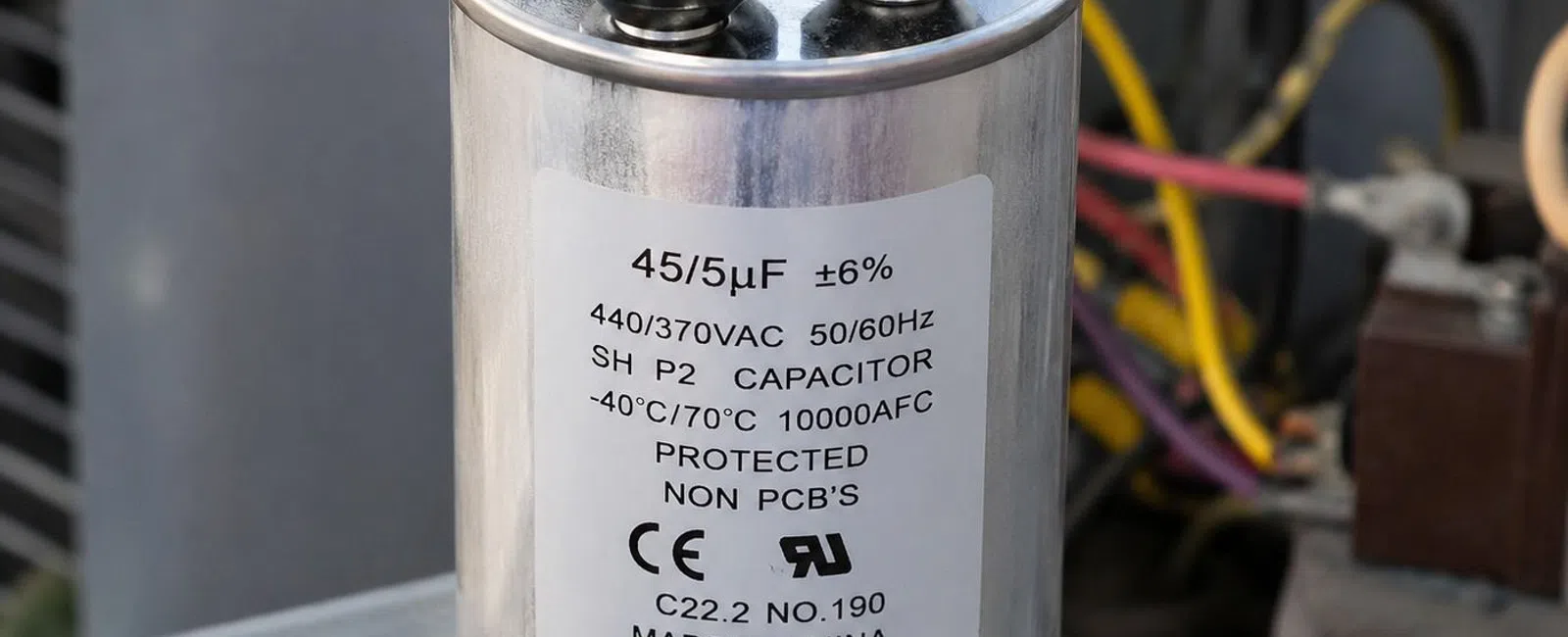
An AC capacitor is a small cylinder inside your outdoor unit that stores electrical energy and releases it on demand to start and run your air conditioner's motors. Without it, the compressor and condenser fan cannot begin turning and cannot keep turning smoothly once they do. It is one of the smallest parts in the system and one of the most common reasons an Atlanta AC quits.
The Capacitor Solves a Problem Built Into Household Power
Your home runs on single-phase power, fine for lights and outlets but a real obstacle for large electric motors. A motor needs a magnetic field that rotates around its windings in order to spin, and single-phase power does not produce one on its own. It pushes and pulls along a single line instead of sweeping around a circle.
The capacitor bridges that gap. It holds a charge on one set of windings and releases it slightly out of step with the incoming power. That timing offset makes the magnetic field sweep in a direction rather than simply oscillate, and the motor shaft follows it. The capacitor gives the motor something to chase.
Start and Run Are Two Separate Jobs
The Start Function Breaks the Motor Free
A compressor is a heavy sealed pump, and getting it moving from a dead stop takes far more electricity than keeping it moving. The start function dumps a large, brief surge of stored energy into the motor to overcome that resistance, then steps aside a fraction of a second later.
The Run Function Keeps Everything Turning
Once the motor is up to speed, the run function takes over for the entire cooling cycle, feeding a steady timed current that holds the rotating field in place and keeps the motor pulling efficiently instead of straining. A motor running on a weak capacitor draws more amperage for the same work, which shows up on your power bill before it shows up as a breakdown.
Most Residential Systems Combine Both Into One Part
Open a residential condenser and you will typically find one oval or round canister with three terminals marked C, HERM, and FAN. That is a dual run capacitor, serving the compressor and the condenser fan motor from a single housing. Efficient packaging, but it means one failed part can stop two motors at once.
Georgia Heat Is Hard on Capacitors
Capacitors are wear parts everywhere. In the Atlanta metro, they wear faster, for three reasons.
Heat comes first. A capacitor lives in a metal cabinet sitting in full sun, next to a compressor generating its own heat, through a cooling season that runs from spring into October. Sustained high temperature degrades the internal materials that let it hold a charge. Run time comes second. A system cycling seven or eight months a year piles up far more hours than the same equipment installed farther north, and every cycle asks the capacitor to charge and discharge again.
Electrical events come third. North Georgia summers bring afternoon thunderstorms, and the voltage swings that follow storm activity and grid switching hit capacitors hardest, because voltage is what they are built to hold. A unit that ran fine Tuesday and will not start Wednesday after an evening storm is a pattern our technicians see often.
Weak Capacitors Fail Gradually Before They Fail Completely
A capacitor is rated in microfarads, printed on the label alongside a voltage rating and a tolerance range. Failure is rarely instant. Capacitance drifts downward, the motors compensate by drawing harder, and the system keeps cooling while the compressor works under strain it was never designed to carry. This is why a capacitor reading belongs in every AC tune-up. A technician measures actual capacitance against the label and catches a part that has fallen out of range while it is still running.
Running a System With a Failed Capacitor Puts the Compressor at Risk
If your outdoor unit is humming without starting, shut the system off at the thermostat and leave it off. A compressor receiving power but unable to start keeps trying, and each attempt generates heat inside a motor with no airflow moving across it. Windings overheat and burn out.
A capacitor is a modest, same-day repair. A failed compressor often means replacing the outdoor unit or the whole system, and letting a struggling unit keep struggling is how the first problem becomes the second.
Capacitor Replacement Is Not a Safe DIY Repair
Capacitors hold a charge after the power is off. Pulling the disconnect at the outdoor unit or flipping the breaker does not empty one, and the stored voltage is high enough to cause serious injury. Technicians discharge them deliberately, with the right tool, before touching a terminal.
Correct diagnosis also takes more than swapping a part. A capacitor that fails early is usually reporting a different problem: a failing contactor, a fan motor pulling excess current, low voltage at the unit, or a compressor starting to degrade. Replace it without checking those, and the new one fails too. If your unit is down right now, our emergency AC repair team covers the Atlanta metro.
Get a Straight Answer on Your System
A capacitor is a small part with an outsized effect on whether your air conditioner survives an Atlanta summer. If your outdoor unit is humming without starting, hesitating on start-up, or blowing air that never turns cold, MR. HVAC can test it and tell you what is actually happening. Schedule service, and we will send a technician out.


